Cone Beam CT Scan
Temecula, CA
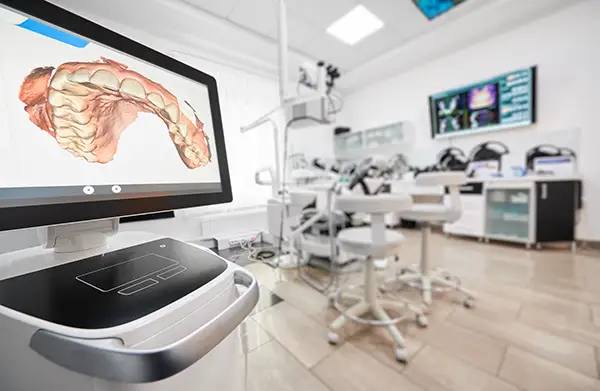 Hearing that you need a "CT scan" can sound more involved than it actually is. At Picasso Dental Care, cone beam CT (CBCT) imaging is a quick, comfortable, in-office procedure that takes less time than most people expect and delivers far more diagnostic detail than a traditional dental X-ray. Learning what happens during the scan, and why it is such a low-impact part of your visit, can help ease any uncertainty before your appointment. Hearing that you need a "CT scan" can sound more involved than it actually is. At Picasso Dental Care, cone beam CT (CBCT) imaging is a quick, comfortable, in-office procedure that takes less time than most people expect and delivers far more diagnostic detail than a traditional dental X-ray. Learning what happens during the scan, and why it is such a low-impact part of your visit, can help ease any uncertainty before your appointment.
How the Scan Is Performed
A cone beam CT scan is taken using a machine that rotates a single time around your head while you remain seated or standing in a fixed position. Unlike a hospital-grade medical CT scanner, which uses a fan-shaped beam and takes many separate image slices, a cone beam scanner uses a cone-shaped X-ray beam to capture the entire area of interest in one rotation. This design is part of what allows dental CBCT units to use significantly lower radiation levels than medical CT imaging.
During the scan, you will be asked to remain still with your teeth together, often biting gently on a small guide, while the machine completes its single rotation around your head. The entire process typically takes less than a minute, and there is no need for any injections, contrast dye, or sedation. Most patients describe the experience as similar to a standard panoramic dental X-ray, just with a brief rotating motion around the head.
Understanding Radiation Exposure
One of the most common questions patients ask is how much radiation a cone beam scan involves. Dental CBCT imaging uses a fraction of the radiation dose associated with a traditional medical CT scan, and the exposure from a single scan is comparable to, or in some cases lower than, the radiation received during a full set of traditional dental X-rays or a short airplane flight.
Our team follows the same principle that governs all dental imaging: exposure is kept as low as reasonably achievable while still capturing the diagnostic detail needed for your specific situation. This means we only recommend cone beam imaging when the added detail it provides will meaningfully inform your diagnosis or treatment plan, not as a routine substitute for standard X-rays.
Why the Detail Is Worth the Scan
Although the scan itself takes less than a minute, the resulting image contains an extraordinary amount of information. A single CBCT scan produces a three-dimensional model of your jaw, teeth, sinuses, and surrounding bone that our team can rotate, section, and measure from any angle. This level of detail supports more accurate diagnosis and treatment planning across a wide range of procedures, from implant placement to root canal evaluation to airway assessment.
Because so much information is captured in a single pass, a cone beam scan can often reduce the need for multiple imaging appointments later in treatment. The same scan used for initial diagnosis frequently serves as a reference throughout the course of care.
Before, During, and After Your Scan
Preparing for a cone beam scan requires very little on your part. You will be asked to remove any metal objects near your head or neck, such as glasses, earrings, or hairpins, since metal can interfere with image clarity. There is no fasting requirement, no need to arrange for someone to drive you home, and no recovery time needed afterward. Most patients return to their normal activities immediately.
Once the scan is complete, our team reviews the resulting images, often within the same visit, and walks you through what they show in terms you can understand. If the scan was taken to evaluate a specific concern, such as an impacted tooth or a possible infection, we will explain the relevant findings directly and discuss how they inform your treatment options.
When Cone Beam Imaging Is Recommended
Not every dental visit requires a CBCT scan. Our team recommends this imaging selectively, when the complexity of a case calls for three-dimensional detail that standard X-rays cannot provide. This includes situations involving implant planning, impacted teeth, unusual root anatomy, suspected infections near the sinus or nerve, jaw joint evaluation, and certain orthodontic or surgical cases. If your treatment does not require this level of detail, we will rely on the imaging methods best suited to your specific needs.
Questions Patients Often Ask
Many patients want to know whether a cone beam scan will need to be repeated, and the answer depends on the reason for the original imaging. A scan taken for implant planning may remain relevant throughout the course of treatment, while a scan taken to monitor healing after a procedure may be repeated at a later date for comparison. Our team will always explain whether and when a follow-up scan makes sense for your particular situation, rather than scheduling repeat imaging as a matter of routine.
Patients also frequently ask whether the scan can detect anything beyond the specific concern that prompted it. Because a CBCT scan captures such a wide anatomical area, it is possible for our team to notice an unrelated finding while reviewing the images, such as a sinus abnormality or an unusual bone pattern. When this happens, we will always discuss what was seen, what it likely means, and what, if anything, should be done next, so you leave your appointment with a clear understanding of your results.
A Comfortable Step Toward a More Informed Treatment Plan
For most patients, the idea of the scan is more intimidating than the experience itself. A cone beam CT scan is quick, painless, and requires no special preparation or recovery, while providing our team with diagnostic detail that meaningfully shapes the accuracy and safety of your treatment plan. If you have a scan scheduled, or if you are wondering whether one may be recommended for your care, our team is glad to answer any questions you have beforehand.
Call (951) 383-2021 to speak with our team at Picasso Dental Care about what to expect from your upcoming visit, or to ask whether cone beam imaging is right for your treatment plan.
|